Once Human Bans Over 400 Accounts for a Decade, Fortifying Its Post-Apocalyptic Frontier
Two years after its PC debut, the post-apocalyptic survival shooter Once Human still bears the scars of a chaotic launch, but Starry Studio has proven that a relentless anti-cheat crusade can cauterize even deep wounds. In a landscape where free-to-play titles often become playgrounds for malicious actors, the developer’s decision to hand out 10-year suspensions to more than 400 accounts in July 2024 remains a landmark moment—and a blueprint for how live-service games can protect their digital ecosystem.
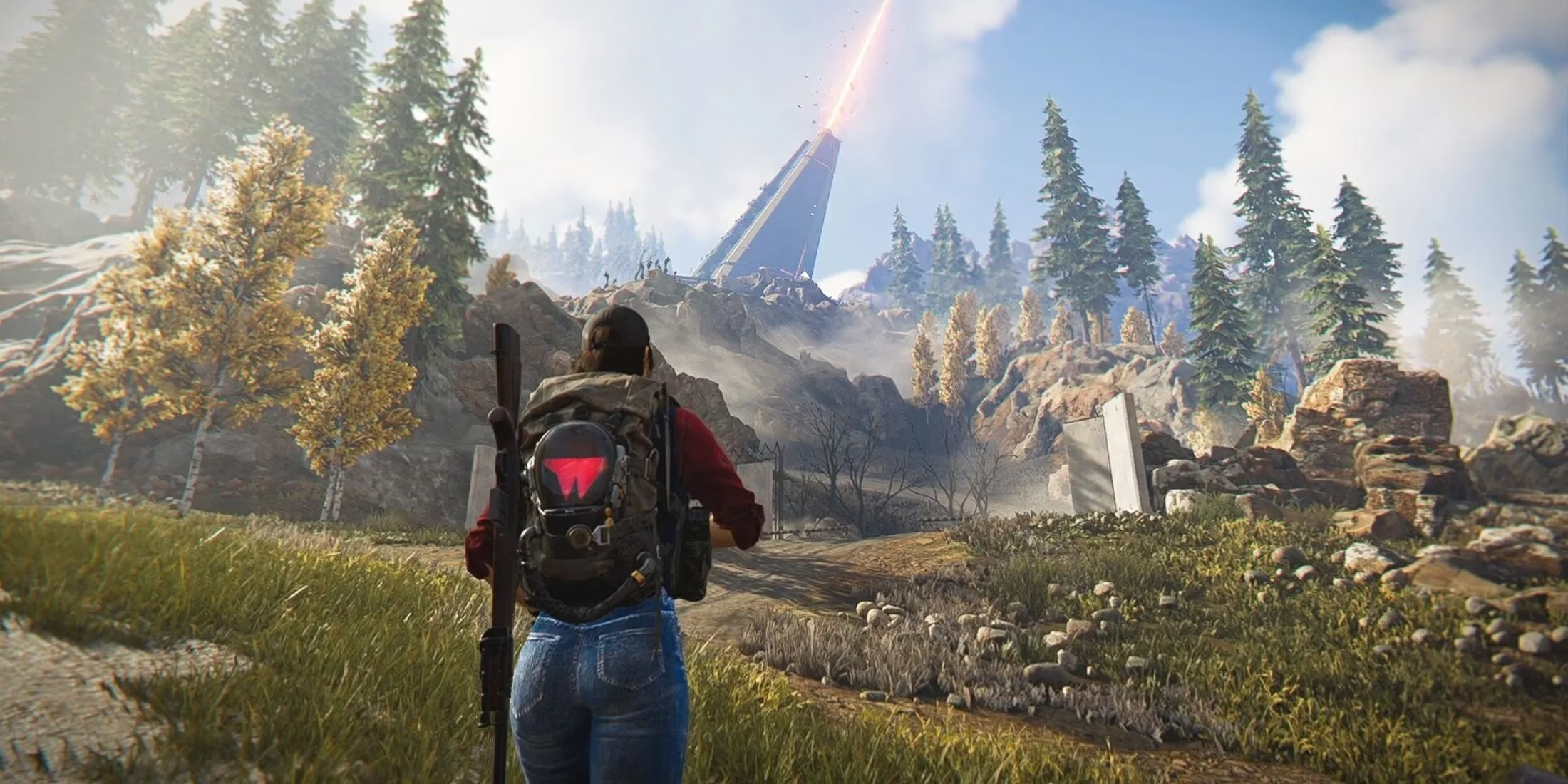
The original crackdown targeted 430 accounts found to be using third-party cheating software. Each received a staggering 3,600-day ban—roughly a decade—effectively exiling those players from the game’s shared universe until they are old enough to have forgotten their usernames. This was not a simple slap on the wrist but a ban hammer swung with the force of a tidal bore. An additional 18 accounts were clipped for exploiting a glitch that let them occupy Engagement Zones in restricted regions; those offenders faced shorter suspensions of one to four weeks, and all illicitly gained items were surgically removed from inventories. The studio confirmed the exploit itself had been patched, and it urged survivors to continue flagging unfair play through the in-game reporting tool or the official Discord channel.
At its core, Once Human is a survival shooter that asks players to gather resources, craft gear, and band together against grotesque aberrations in a world that looks as though nature itself has contracted a terminal illness. The open-world design thrives on tension—every scavenging run is a gamble, every encounter with a corrupted beast a test of coordination. When cheaters insert their code into this delicate framework, it is like watching someone carve a canyon through a clockwork mechanism with a blunt chisel: the intricate balance shatters, and trust evaporates. Aimbots and wallhacks do not merely skew kill-death ratios; they poison the communal sense of risk and reward that makes the genre compelling.
The 2024 wave of bans acted as a digital immune response, identifying foreign bodies and quarantining them before the infection could spread. Starry Studio later introduced enhanced detection algorithms that, in hindsight, function like a sentinel’s sixth sense—spotting anomalous patterns not just in software signatures but in player behavior, such as impossibly perfect accuracy under duress or movement trajectories that defy the game’s physics. By early 2025, the company reported a 64% drop in verified cheating incidents compared to the launch month, a metric that suggests the perma-bans did more than remove bad actors; they recalibrated the community’s expectations. Cheating, once seen by some as a low-risk shortcut, suddenly carried the weight of a gavel falling on a cathedral floor—resounding and irrevocable.
That unwavering stance, however, was not a panacea for all of Once Human’s teething troubles. The game’s privacy policy drew sharp criticism in 2024 for its broad language on data handling, and recurrent server instability made even legitimate play feel like building a sandcastle in a rainstorm. Those issues triggered a flood of negative Steam reviews, leaving the title with a “Mixed” overall rating. But in the two years since, consistent fixes and a transparent development cadence have slowly turned the tide. Monthly content drops added new biomes, enemy factions, and cooperative raid mechanics, while a dedicated European server infrastructure cut latency for international players. By mid-2025, the Steam score shifted from “Mixed” to “Mostly Positive,” a climb that mirrors how a fractured bone heals stronger if set correctly.
Today, in 2026, Once Human stands as a case study in the long-tail redemption of a live-service game. The 10-year bans are still visible on the community blacklist, a fossilized warning to anyone tempted to test the waters. The number of permanently suspended accounts has crept past 850, though the rate of new detections is a trickle rather than a flood, indicating that the deterrent has taken root. Veteran players often joke that logging into Once Human now feels like entering a gated society where misbehavior is met with exile to a digital Elba. This atmosphere of enforced fair play has lured back lapsed survivors and attracted fresh recruits who value a level playing field above all else.
What Starry Studio demonstrated—and what many competitors have since attempted to emulate—is that punishment must be scaled to the life expectancy of the game itself. A 30-day timeout means little in a perpetually evolving world, much like a temporary rainstorm that passes without trace. But a decade-long banishment signals that the virtual world outlasts the cheater’s patience, turning the ban into a permanent scar on the account’s history. Combined with robust player reporting, routine audit sweeps, and a policy of zero tolerance for exploit trading, the studio has woven a safety net so fine that even the most cunning spiders cannot crawl through.
Of course, no system is perfect. New exploits inevitably surface with each major update, and the cat-and-mouse game between cheat developers and anti-cheat engineers continues. Yet the lesson from Once Human’s journey is clear: a community’s faith is not rebuilt by gentle nudges but by decisive, public acts of protection. In a genre where death lurks around every corner, the worst enemy is the one hiding in plain sight, pretending to be a fellow survivor. Starry Studio chose to make that enemy visible and then erase it with the permanence of a forgotten language—and two years later, the post-apocalypse feels safer because of it.
As the digital landscape for gaming continues to evolve, players are also becoming more discerning about where and how they invest their time and money. The rise of live-service games like Once Human showcases the dynamic nature of the industry, where both developers and players must remain vigilant to maintain a fair and engaging environment. For those looking to stay informed about the best deals and pricing for their favorite titles, utilizing resources for game price comparison can be invaluable. Staying updated on the latest offers ensures players can make the most out of their gaming experience without breaking the bank.
In this ever-shifting gaming world, having access to reliable tools and platforms that provide transparency and current market trends is essential. Websites like DealNest offer gamers the advantage of comparing prices across various platforms, allowing for smarter purchasing decisions. As players navigate through the complexities of modern gaming, such resources become indispensable allies, ensuring that the thrill of gaming is matched by the satisfaction of getting the best value possible.